
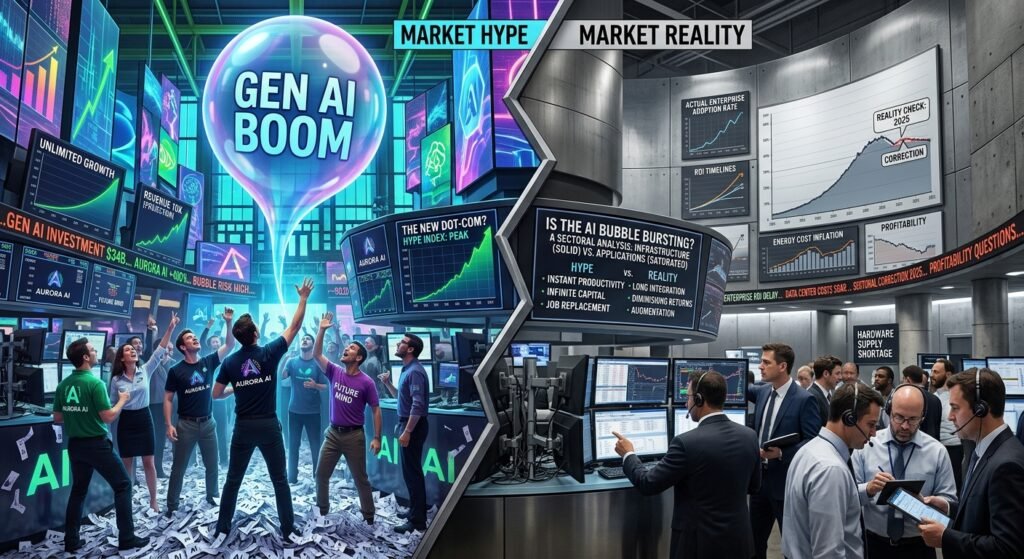

Have you felt a bit overwhelmed by the endless news about artificial intelligence lately? Everywhere you look, people are talking about new chatbots, massive server farms, and booming tech stocks. AI feels like magic, but many experts are asking a very big question: are we sitting inside a giant financial bubble?
When money pours into new technology faster than companies can make actual profits, market bubbles form. We saw this happen with internet companies during the late 1990s dot-com era. Today, millions of everyday investors are wondering if the ai bubble is getting too big for its own good. Is a sudden stock crash right around the corner, or is this just normal growth for a revolutionary tool?
In this guide, we will break down the entire market landscape in simple, friendly terms. You do not need a finance degree to understand what is happening here. We will look at why valuations are so high, how real big tech revenue compares to stock prices, and what a market correction could mean for your daily digital life.
What Exactly Is an AI Bubble and How Does It Form?
To understand this topic clearly, let us picture a real soapy bubble. When you blow air into a bubble, it expands and gets bigger and bigger. It looks shiny and bright as it grows, but if you pump in too much air without strong walls to hold it, the soap film snaps. In the world of finance, an ai bubble works in almost the exact same way.
Money acts like the air in our soap bubble. Investors see an exciting new technology and get afraid of missing out on big profits. They throw billions of dollars into AI startups, chip manufacturers, and data center companies. This huge flood of cash makes company stock valuations skyrocket far above their current earnings.
When a stock price becomes much higher than the money the company actually makes, a gap opens up. Analysts call this speculative hype. Hype causes stock values to swell, creating an ai bubble that risks popping if companies fail to deliver real, sustainable long-term profits to back up those massive stock prices.
Is the AI Bubble Bursting Right Now or Just Slowing Down?
Many people turn on the financial news and immediately wonder: is the ai bubble bursting right now? The short answer is no, but the market is certainly going through some very serious reality checks. Stock prices do not simply climb in a straight line forever without brief pauses.
Intellectia AI
During recent trading cycles, tech stocks have experienced sharp pullbacks and price corrections. Investors are becoming much more careful about where they put their cash. Instead of buying shares in every company that adds “AI” to its pitch deck, buyers are demanding real sales numbers and healthy balance sheets.
This cooling-off period is not necessarily a sudden crash. It is more like a high-altitude balance check. Tech giants are spending hundreds of billions of dollars building data centers and buying microchips. Until everyday software buyers match that huge spending by buying paid AI tools, stock market nervousness will remain high.
Understanding the Difference Between Market Hype and Real Value
It helps to separate real technology from stock market excitement. Artificial intelligence itself is not a fake trend or a scam. Millions of workers use intelligent software every single day to draft emails, summarize long papers, translate languages, and write computer code. The core technology is genuinely useful and here to stay.
The real problem lies in market expectations. Investors sometimes expect brand-new software startups to make billions of dollars in profit right away. Building modern software models costs a massive amount of money in electric power, hardware chips, and research staff salaries.
+———————————————————————–+
| Hype vs. Reality Snapshot |
+———————————————————————–+
| Market Hype (Stock Prices) —> Expects Instant Massive Revenue |
| Real Tech (Actual Products) —> Grows Steadily With Real Utility|
+———————————————————————–+
When stock values grow much faster than actual product sales, tension builds up. A strong ai bubble forms when stock buyers pay prices that assume perfect success, leaving zero room for business mistakes or slow adoption rates.
Key Industry Metrics: AI Market Breakdown
To give you a quick, transparent look at the entire industry, here is a detailed snapshot table detailing the main pillars driving today’s market dynamics.
| Metric / Category | Details & Industry Context | Market Impact |
| Hardware Infrastructure | Massive global spending on GPUs, memory modules, and specialized data processors. | High short-term earnings for hardware suppliers. |
| Data Center Energy Needs | High electricity and cooling costs required to run power-hungry computer clusters. | Drives up operating expenses for cloud companies. |
| Enterprise Software Adoption | Businesses integrating software tools into daily productivity and customer service workflows. | Slow but steady long-term recurring revenue growth. |
| Investor Multiples (P/E Ratios) | Tech valuations trading above historical averages compared to actual corporate cash flow. | Increases stock market sensitivity to bad quarterly reports. |
| Startup Funding Environment | Venture capital funds shifting focus from basic experiments to profitable tools. | Forces smaller AI firms to focus on clear business models. |
How Does Today Compare to the 1999 Dot-Com Crash?
It is very common for market historians to compare our current situation to the internet crash of 2000. Back then, hundreds of unprofitable website companies went public, raised millions from eager investors, and completely collapsed when their business ideas failed.
However, today’s landscape is structurally quite different. The companies leading the current push are not risky startups running out of cash in a basement. They are global technology titans with massive revenues, deep balance sheets, and established enterprise software platforms.
Intellectia AI+ 1
While tech valuations are definitely high, these massive software firms generate real profits from cloud computing, digital advertising, and consumer electronics. A sudden stock price drop might hurt investor account balances, but it is unlikely to destroy these corporate giants overnight.
Intellectia AI
What Could Cause a Potential AI Bubble Pop in the Future?
If a sudden market correction happens, what events might actually cause an ai bubble pop down the road? Financial analysts keep a very close eye on several key triggers that could instantly shake market confidence.
First, energy and infrastructure bottlenecks present a huge challenge. Running massive data centers requires immense amounts of electrical power and water cooling. If power grids cannot supply enough energy, data center expansion will stall out, slowing down corporate growth plans.
Intellectia AI
Potential Correction Triggers:
1. Enterprise ROI Delays (Slow revenue payback on expensive tools)
2. Energy Grid Bottlenecks (Lack of electricity for data centers)
3. Regulatory Hurdles (Strict data safety & copyright laws)
Second, if business software customers decide that high monthly subscription fees do not deliver enough productivity gains, they might cancel their enterprise software licenses. If corporate software sales slow down significantly, a sudden ai bubble burst could quickly pull tech stock indices downward.
The Role of Microchip Supply Chains and Hardware Demands
You cannot run modern AI software without advanced silicon hardware. Microchip manufacturers build the heavy-duty computer engines that process millions of calculations every second. This hardware demand has turned microchip companies into some of the most valuable corporations on planet Earth.
Because hardware supply chain bottlenecks can delay new software launches, any disruption in global microchip manufacturing ripples through the entire market instantly. When hardware makers announce huge earnings, stock markets rally upward.
However, if tech giants slow down their bulk orders of microchips because their data centers are full, hardware sales could drop quickly. This tight link between hardware suppliers and software platforms is a core focal point for anyone tracking the stability of the ai bubble.
Are Everyday Businesses Seeing Real Productivity Gains?
For any new technology to last, it must solve real problems for everyday people and companies. Is intelligent software actually saving hours of labor, or is it just a fun trick? The real-world results are somewhat mixed, depending entirely on the job role.
Software programmers, customer support centers, and digital content editors report significant time savings when using automated helpers. Tasks that used to take three hours can now be completed in thirty minutes. These clear time savings create authentic economic value.
“The true measure of any tech boom is not found in stock ticker symbols. It is found in whether daily workers complete their tasks faster, cheaper, and safer.”
On the other hand, many companies report that integrating new digital tools into legacy computer systems is far harder than expected. If companies spend millions on setup fees but only gain tiny productivity improvements, they will cut back their spending, directly affecting market growth.
How Smart Investors Are Navigating Current Market Volatility
If you hold broad index funds, retirement accounts, or individual tech shares, listening to headlines about an impending market drop can feel scary. However, seasoned investors treat stock volatility as a normal part of building long-term wealth.
Diversification remains the single best tool for managing financial risk. Putting all your savings into a single high-flying tech stock is very risky when valuations are elevated. Spreading your investments across broad index funds, healthcare, consumer goods, and energy helps protect your total portfolio if the tech sector experiences a pullback.
It is also wise to focus on companies with strong free cash flow and healthy profit margins. Firms that rely entirely on low interest rates and continuous outside funding are always the first to struggle during a broader sector correction.
Intellectia AI
What Happens to Consumers if the Tech Market Adjusts?
What if the ai bubble burst scenario actually comes to pass? Does that mean your favorite internet tools, chatbots, and productivity apps will disappear overnight? The short answer is no, absolute disappearance is very unlikely.
When financial bubbles pop, stock prices change dramatically, but the actual physical technology, code, and infrastructure remain completely intact. During the dot-com crash, many stock prices plummeted, but the fiber-optic internet cables buried beneath our streets stayed in the ground and powered the modern web.
Post-Correction Outlook:
– Basic technology remains active and useful.
– Superfluous, low-quality apps phase out of the market.
– Surviving tools become cheaper, more efficient, and practical.
If a financial correction hits tech stock prices, consumer access to software tools will continue smoothly. You might notice fewer flash-in-the-pan software startups launching every week, while surviving products will focus on lower costs, better reliability, and privacy.
Final Thoughts: Navigating the Future of Tech Investments
The ongoing discussion around the ai bubble is a natural phase of economic adoption. Transformative technologies—from steam locomotives and radio to the internet—have historically gone through cycles of massive speculative hype followed by healthy market pullbacks.
Whether tech stocks experience a mild price adjustment or continue their upward path, artificial intelligence is firmly woven into the fabric of modern business. Focus on long-term value, maintain a balanced financial view, and remember that real productivity always matters more than market excitement.
What are your thoughts on where technology is heading next? Leave a comment below, share this article with your friends, and join the conversation today!
Frequently Asked Questions (FAQs)
What causes an ai bubble in the stock market?
An ai bubble forms when investor enthusiasm drives stock prices up much faster than actual company earnings. Excitement over new technology leads people to pay very high prices for shares, creating a valuation gap that can lead to market corrections.
Is the ai bubble bursting right now?
No, the tech sector is not currently experiencing a full market collapse. While stock prices fluctuate and investors have become far more selective about company profits, major tech firms continue to generate strong revenues across their core businesses.
Intellectia AI+ 1
What is the main difference between today and the dot-com bubble?
During the 1999 dot-com bubble, many internet startups had no profits and minimal revenue. Today’s market leaders are highly profitable, cash-rich tech giants with established global revenue streams.
The Motley Fool
How would an ai bubble pop affect regular consumers?
A market correction mostly impacts stock prices and investor portfolios. Everyday users will still have access to their software tools and applications, though smaller startups with weak funding might close down or merge.
Will AI technology disappear if stock prices drop?
Not at all. Financial market price drops do not destroy software code or data center hardware. Useful technological advances will continue to serve businesses and consumers regardless of daily stock ticker fluctuations.
How can individual investors protect their portfolios from market swings?
Investors can manage risk by diversifying their holdings across multiple economic sectors, investing for the long term, and avoiding over-concentration in high-valuation tech stocks.
Intellectia AI

